
 Image 1 of 1
Note:
For laboratory research use only.
Not intended for human consumption or therapeutic use.
Handling by trained research professionals is required.
GHRP-6 (Growth Hormone-Releasing Peptide 6) is a synthetic hexapeptide that acts as a potent stimulator of growth hormone (GH) secretion.
Molecular Information
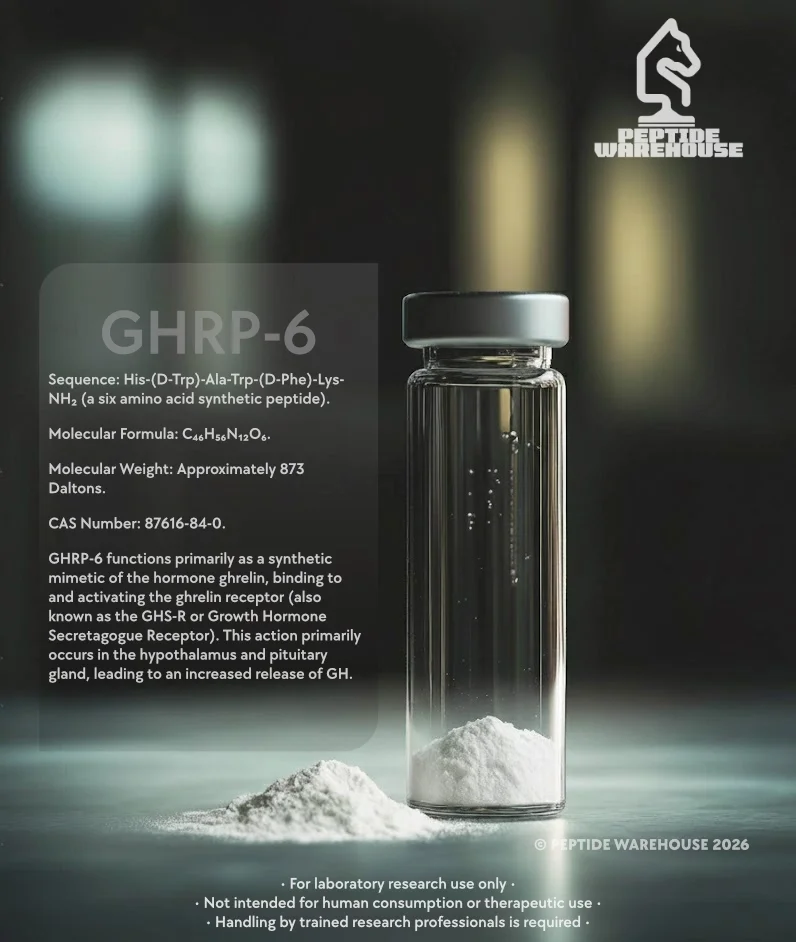
Sequence: His-(D-Trp)-Ala-Trp-(D-Phe)-Lys-NH₂ (a six amino acid synthetic peptide).
Molecular Formula: C₄₆H₅₆N₁₂O₆.
Molecular Weight: Approximately 873 Daltons.
CAS Number: 87616-84-0.
Function and Mechanism
GHRP-6 functions primarily as a synthetic mimetic of the hormone ghrelin, binding to and activating the ghrelin receptor (also known as the GHS-R or Growth Hormone Secretagogue Receptor). This action primarily occurs in the hypothalamus and pituitary gland, leading to an increased release of GH.
Therapeutic Potential and Research
Beyond its role in GH release, research has shown GHRP-6 to have several other effects in preclinical experimental models:
Cytoprotective effects: It has shown promise in reducing tissue damage during acute ischemia/reperfusion episodes in organs like the heart, liver, and kidneys.
Anti-inflammatory and antioxidant activity: It helps sustain cellular antioxidant defenses and reduces inflammatory markers.
Wound healing: Studies have indicated it can enhance the healing process.
Food intake: It can stimulate hunger and increase food intake.
GHRP-6 (Growth Hormone-Releasing Peptide 6) is a synthetic hexapeptide that acts as a potent stimulator of growth hormone (GH) secretion.
Molecular Information
Sequence: His-(D-Trp)-Ala-Trp-(D-Phe)-Lys-NH₂ (a six amino acid synthetic peptide).
Molecular Formula: C₄₆H₅₆N₁₂O₆.
Molecular Weight: Approximately 873 Daltons.
CAS Number: 87616-84-0.
Function and Mechanism
GHRP-6 functions primarily as a synthetic mimetic of the hormone ghrelin, binding to and activating the ghrelin receptor (also known as the GHS-R or Growth Hormone Secretagogue Receptor). This action primarily occurs in the hypothalamus and pituitary gland, leading to an increased release of GH.
Therapeutic Potential and Research
Beyond its role in GH release, research has shown GHRP-6 to have several other effects in preclinical experimental models:
Cytoprotective effects: It has shown promise in reducing tissue damage during acute ischemia/reperfusion episodes in organs like the heart, liver, and kidneys.
Anti-inflammatory and antioxidant activity: It helps sustain cellular antioxidant defenses and reduces inflammatory markers.
Wound healing: Studies have indicated it can enhance the healing process.
Food intake: It can stimulate hunger and increase food intake.
Note:
For laboratory research use only.
Not intended for human consumption or therapeutic use.
Handling by trained research professionals is required.